
Organic Growth in Wealth Management Starts at the First Interaction
Behavioral Intelligence Brief #1
Organic growth in wealth management has slowed to historic lows.
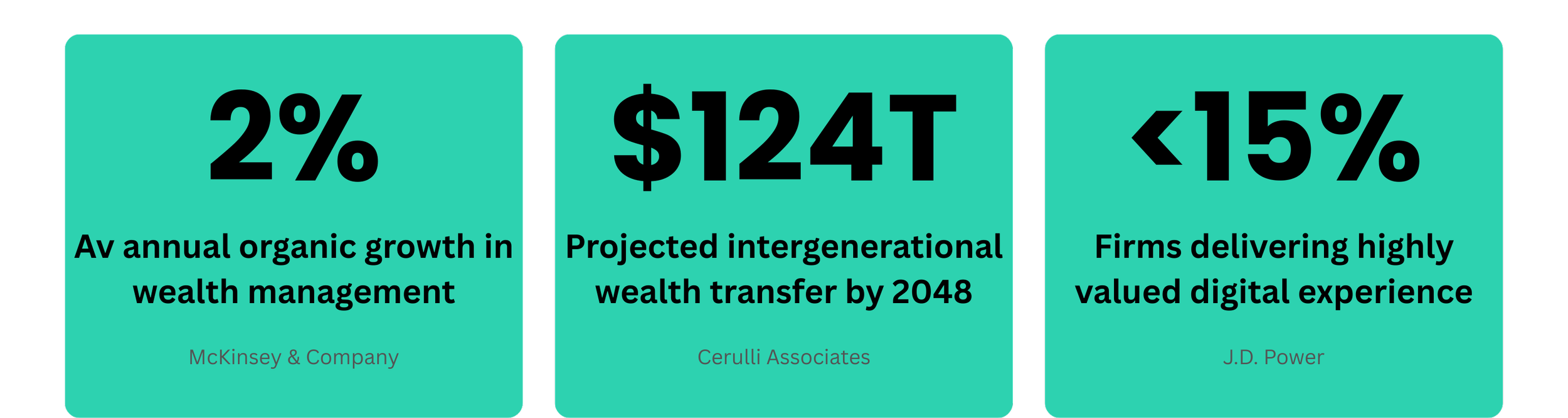
McKinsey reports that industry organic revenue growth has averaged roughly 2 percent annually in recent years.¹ At the same time:
Cerulli estimates $124 trillion will transfer across generations by 2048.²
Bain research shows up to 50 percent of clients consider switching advisors after major life events.³
J.D. Power reports fewer than 15 percent of wealth firms deliver a highly valued digital experience.⁴
The opportunity is enormous, and the margin for error is shrinking.
Over the past 20 years working in and around wealth management, I’ve seen the same pattern play out repeatedly. Firms invest heavily in marketing, recruiting, and brand.
Yet the most fragile growth moment is in the space between a prospect’s initial interest and their decision to commit. It’s when curiosity has been sparked, but trust has not yet been fully formed. This is where deals are won or lost.
The Hidden Constraint on Advisor Growth
Advisory firms assume growth problems are marketing problems.
More leads. Better messaging. More referrals. You’re familiar with more than a few lead generation platforms that operate on this assumption.
The real constraint appears when a prospect raises their hand and the firm does not have a structured way to turn interest into alignment.
McKinsey research shows firms that effectively use behavioral and client insight can increase sales productivity by 10–20 percent.⁵ The Schwab RIA Benchmarking Study reinforces this: top-performing RIAs differentiate through disciplined client experience and operational consistency, not simply portfolio results.⁶
Yet most prospect engagement still relies on an informal discovery process.
Over the years I’ve heard many advisors say the same thing: “Prospects tell me what they think I want to hear.”
Behavioral research suggests they may be right. Studies in financial behavior show that individuals often adjust their answers to appear responsible or socially acceptable, a phenomenon known as social desirability bias, which can lead to misrepresentation of true preferences.¹²
Research has also documented a persistent communication gap between advisors and clients. In one study, 87% of financial planners reported discussing care plans for loved ones with clients, yet only 23% of investors recalled the conversation, highlighting how easily intentions and understanding can diverge.¹³
Prospects want to appear financially responsible. They want to appear thoughtful. They want to say the “right” thing in front of an advisor. But that dynamic can obscure the deeper motivations behind why they reached out in the first place.
And if those motivations remain unclear, conversion becomes fragile.
Behavioral Insight Is a Revenue Engine
Behavioral finance is sometimes framed as a soft skill. The data tells a different story.
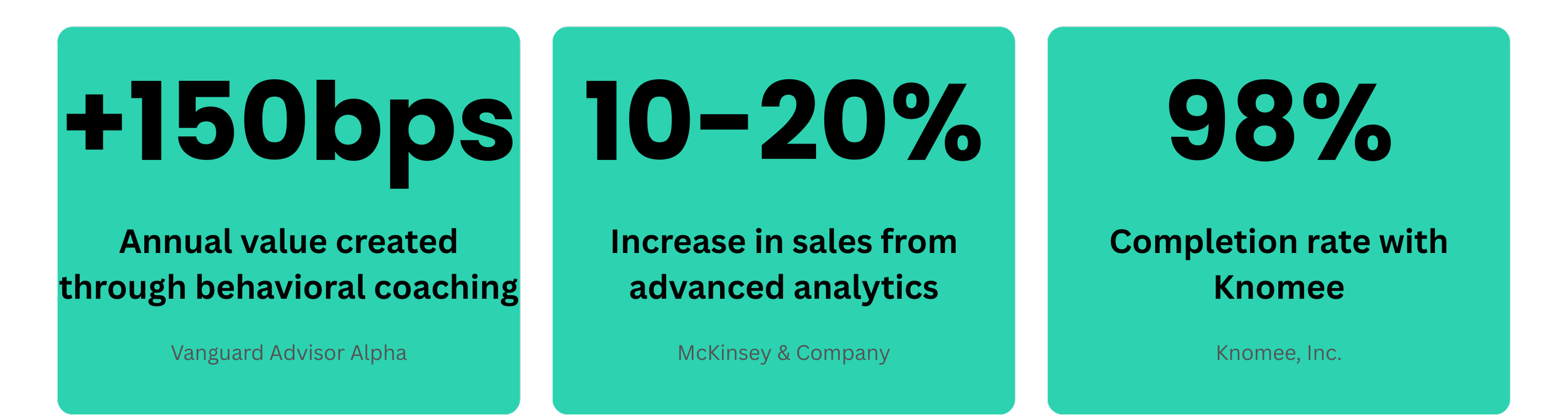
Structured behavioral intelligence drives business growth.
Vanguard’s Advisor Alpha estimates that behavioral coaching alone can add up to 150 basis points of value annually by helping clients make better decisions.⁷ That value strengthens retention, referrals, and long-term client outcomes.
But the growth impact begins even earlier, at conversion.
Cerulli research shows that firms delivering holistic, values-aligned financial planning capture greater wallet share and stronger organic growth than firms focused narrowly on investment management.² Academic research by Grable and Hubble further shows that misalignment between advisors and client behavioral preferences reduces confidence and slows decision-making.⁸
The pattern is simple:
Personalization builds trust. > Trust accelerates commitment. > Commitment drives AUM growth.
Clients rarely hesitate because of investment performance. They hesitate because they are not yet sure the advisor understands what matters to them.
The Conversion Insight Gap
Most advisory firms lose momentum before a prospect ever becomes a client. This isn’t because the advisor lacks expertise, but because the early experience does not help prospects articulate what they actually want from a wealth management relationship.
In many firms, the first meeting still revolves around fact-finding. Advisors gather assets, goals, and risk tolerance while the conversation moves quickly toward portfolios and planning.
Prospects can usually explain what brought them to the meeting. It might be a liquidity event, an inheritance, a career transition, anxiety about markets, or the quiet realization that their financial life has grown more complex than they want to manage alone. But explaining the trigger is different from defining what good looks like.
What would make this relationship valuable?
What outcomes would make the advisor worth choosing now?
Those questions are harder to answer, and they rarely surface clearly in a first conversation.
Without structure, advisors are left to interpret signals in real time. Follow-up relies on instinct, and the value of the advisory relationship remains abstract. Even strong prospects leave a first meeting interested, but unconvinced. This is where many growth strategies quietly stall.
Helping clients translate their motivations into clear expectations is nuanced work. It is a skill grounded in decades of research in behavioral finance, decision science, and effective discovery. When that clarity emerges early, advisors can respond with a differentiated, resonant reason to work together now.
Without it, even great advisors struggle to demonstrate why they are the right choice.
Introducing Conversion Intelligence
Knomee’s Conversion Intelligence Engine was designed for this exact moment in the prospect journey.
Instead of sending a calendar link and hoping the first meeting lands well, advisors share a simple branded URL.
Behind the link is an interactive digital experience that guides prospects through structured self-discovery. The experience is modular, reflective, and intentionally engaging. In pilot deployments we have seen 95% completion rates, a signal that when the process feels personal and relevant, prospects willingly participate.
Prospects do not experience it as a form. They experience it as a moment to think and prepare for their first conversation. They realize that clarifying the below questions…
what they want from a wealth manager
how they define value in an advisory relationship
the outcomes they want their wealth manager to be held accountable to
what is driving their search right now
…enables them to generate more value from the interaction, and the ongoing relationship, if they find it to be a good fit. By the time they meet the advisor, the conversation starts from a very different place.
Advisors receive structured behavioral insight, AI-generated summaries, and conversation prompts built directly from the prospect’s own language. Instead of guessing at priorities, they begin with alignment.
Recently I was speaking with the sales leader of a company that builds AI meeting note-takers for advisors. When he saw what Knomee does, he paused mid-conversation.
He said something that stuck with me.
“We help advisors capture what they already know.
You help them uncover what they don’t know before the meeting even starts.”
Exactly.
Conversion Intelligence surfaces the motivations, expectations, and definitions of value that prospects often struggle to articulate on their own. It gives advisors insight they cannot extract through traditional intake forms or conversation alone.
While prospects gain agency, advisors gain clarity, and the relationship begins with shared language around value and outcomes.
Why This Matters for Advisory Leaders
Several structural forces are reshaping wealth management at once.
More than 100,000 advisors are expected to retire in the coming decade.¹⁰ At the same time, younger investors expect personalization and digital engagement from their financial relationships.⁴ AI tools are proliferating, but most simply automate existing workflows rather than improving client understanding.¹¹
Technology alone will not create differentiation. The advantage will come from firms that operationalize human insight.
The highest-performing advisory firms treat discovery not as a conversation but as infrastructure. They systematize behavioral insight so every advisor can begin relationships with clarity rather than guesswork.
The benefits are measurable: shorter sales cycles, stronger conversion rates, clearer client expectations, and deeper relationships built around client-defined value.
From Insight to Growth
Organic growth in wealth management does not begin with more marketing spend. It won’t come from scraping the web to send an email that references something a prospect said or did nor from sheer lead volume. That’s not the business we’re in. We’re in the business of trust.
Growth happens when a prospect feels understood.
When that moment happens consistently, conversations deepen. Decisions accelerate. Relationships form with clearer expectations. Advisors rediscover capacity to do the thing they love most - helping people live better lives.
Over time, client understanding compounds.
In a decade defined by automation and AI, the most durable competitive advantage will not be algorithms or portfolios.
It will be human insight, structured early and used well.
That is the promise of Conversion Intelligence. We’re so confident you’re going to love it, we price on outcomes, when you learn information that helps you convert.
References
McKinsey & Company. US Wealth Management: A Growth Agenda for the Coming Decade.
Cerulli Associates. Financial Planning: Fueling Client and Business Growth.
Bain & Company. Earning Customer Loyalty in Wealth Management.
J.D. Power. 2024 U.S. Wealth Management Digital Experience Study.
McKinsey & Company. Advanced Analytics in Banking.
Charles Schwab. 2024 RIA Benchmarking Study.
Vanguard. Advisor Alpha.
Grable, J. & Hubble, L. Behavioral Finance Research. SSRN.
McKinsey & Company. US Wealth Management in 2035: A Transformative Decade Begins.
National Association of Plan Advisors (NAPA). Advisor Retirement Statistics.
Financial Advisor Magazine. 2025 RIA AI Survey.
Kelly, N. L. Examining Social Desirability Bias in Measures of Financial Behavior. Illinois State University.
Janus Henderson Investors, Financial Planning Association, Investopedia. Closing the Client Conversation Gap Study.
